


5 min read
Level: Thought experiment Exact astronomy and arithmetic – the meaning of the tones is tradition and imagination.
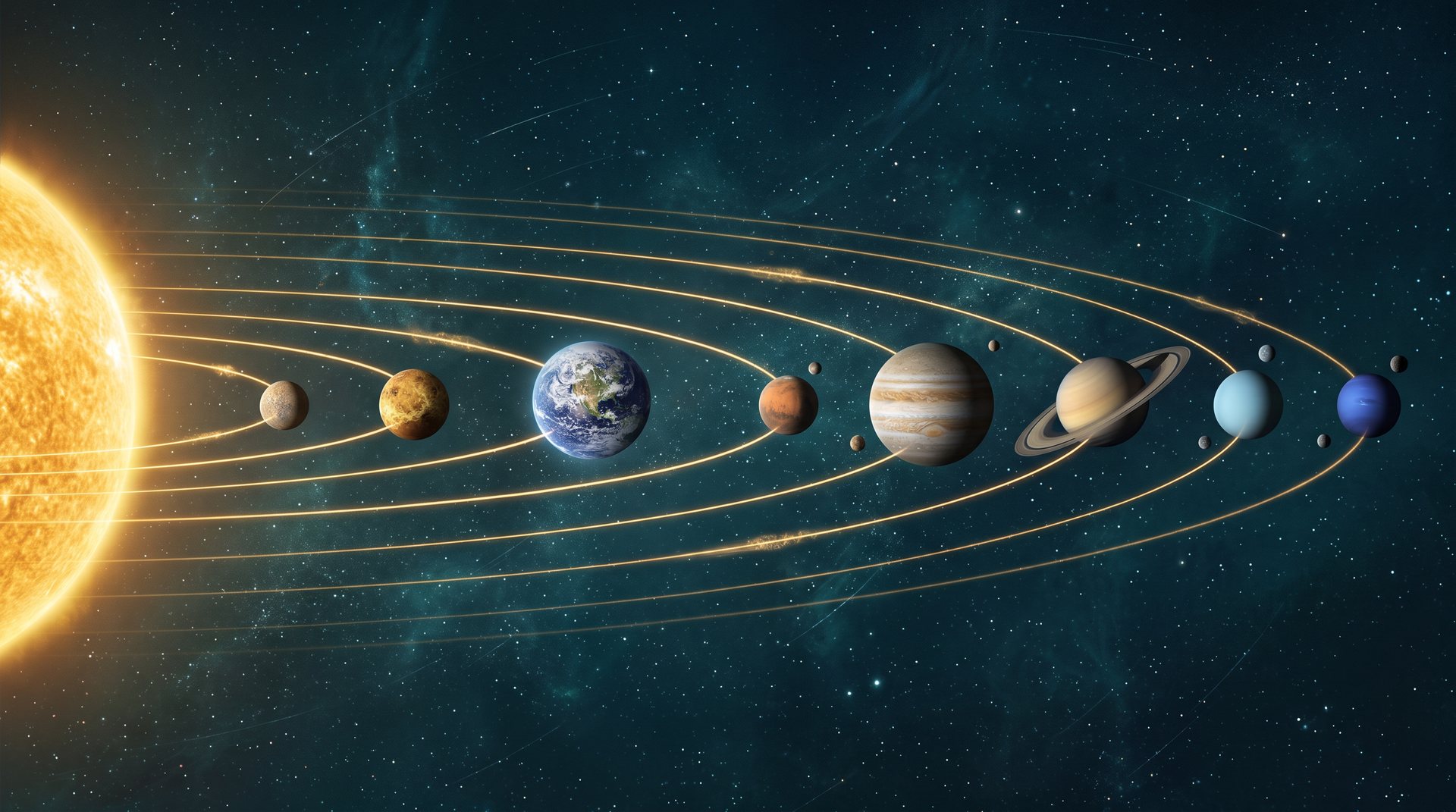
The Earth needs one year to travel around the Sun. Nobody can hear that – one turn per year is an unimaginably slow vibration. But what if we raised it, octave by octave, the way we raise a tone into light? At some point the Earth’s journey around the Sun would become a note you can hum.
An old dream: music of the spheres
The idea that the sky makes music is ancient. Pythagoras is said to have spoken of the “harmony of the spheres”. In 1619 Johannes Kepler published Harmonices Mundi, “The Harmony of the World”. In it he compared the fastest and slowest speed of each planet on its path and found ratios that resemble musical intervals – for the Earth roughly a semitone. In the same book, almost in passing, he wrote down what we still call Kepler’s third law of planetary motion.
Kepler’s planets sang melodies. Nobody could actually hear them – yet.
Hans Cousto and the cosmic octave
In 1978 the author and researcher Hans Cousto took the decisive step. He applied the law of the octave – doubling a frequency – outside of music: to the rotation of the Earth, the orbit of the Earth, the phases of the Moon and the orbits of the planets. He called it the cosmic octave.
The principle is simple and exactly the same one we use for our light octave:
f = 1 ÷ T → f × 2ⁿ
A period T becomes a frequency (one divided by the period). Then we double it until we can hear it. For the Earth year:
- One year = 365.24219 days = 31,556,925 seconds
- Frequency = 1 ÷ 31,556,925 s ≈ 0.0000000317 Hz
- Doubled 32 times: 136.10 Hz
That is the tone Cousto called the tone of the Earth year – in Indian music it is often linked with the syllable “Om”. Today you can buy tuning forks, singing bowls and gongs tuned to exactly these values.
We recalculated the planets
We took the astronomical periods and redid every step – and then went one step further: we doubled each tone on into the visible range, like on our Colour of Sound page. This is the result:
| Cycle | Period | Tone | Light octave | Colour |
|---|---|---|---|---|
| Earth year | 365.24 days | 136.10 Hz | 501 nm | turquoise |
| Earth day | 24 hours | 194.18 Hz | 702 nm | red |
| Moon (new moon to new moon) | 29.53 days | 210.42 Hz | 648 nm | orange-red |
| Mercury | 88.0 days | 141.27 Hz | 483 nm | sky blue |
| Venus | 224.7 days | 221.23 Hz | 616 nm | orange |
| Mars | 687.0 days | 144.72 Hz | 471 nm | blue |
| Jupiter | 11.86 years | 183.58 Hz | 743 nm | deep red |
| Saturn | 29.46 years | 147.85 Hz | 461 nm | indigo |
| Platonic year | 25,920 years | 172.06 Hz | 396 nm | violet |
Our results match the values Cousto published and that instrument makers use today – for example 136.10 Hz for the Earth year, 147.85 Hz for Saturn and 172.06 Hz for the Platonic year.
A beautiful coincidence: 172 and 174
Look at the last row. The Platonic year is the slow wobble of the Earth’s axis, which makes the stars of the zodiac drift across the spring sky; tradition gives it 25,920 years. Its tone is 172.06 Hz – and its light colour violet, at 396 nm.
The lowest of our ten tones is 174 Hz, the tone we connect with grounding and the forest floor. Its light colour is violet as well, at 392 nm. The tone of the great age and the tone of grounding are almost siblings.
And it becomes even closer: modern astronomy gives the wobble of the Earth’s axis as about 25,772 years. With this value the tone rises to around 173 Hz – only a breath away from 174.
Colours of the sky
Cousto himself connected his tones with colours; in 1980 he published a booklet on sound and colour. Our table follows the same idea with today’s numbers. Some pairs are worth a pause:
- The Earth year turns turquoise – the colour of water and of our planet seen from space.
- The Earth day becomes red, the colour of sunrise and sunset that frames every day.
- The Moon glows orange-red, like a full moon rising low over the horizon.
These are not effects, and none of this is astronomy you can feel. It is a way of telling the sky’s rhythms in tones and colours – an invitation to listen to time.
What this is – and what it is not
It is exact: every orbital period is measured, every doubling can be checked with a calculator. It is not a law of nature that connects a planet with your body or your fate. Whether you hear in 136.10 Hz the year, the Earth or simply a warm, deep tone is entirely yours.
Letters from the Atlas
Once a month, at the new or full moon: new articles, a page from the calendar of the year and our newest music. Free, and you can unsubscribe at any time.
Sources
- planetware.de – Hans Cousto: The Cosmic Octave (principle, 1978; sound and colour booklet, 1980)
- Wikipedia – Harmonice Mundi (Kepler, 1619)
- Wikipedia – Axial precession (about 25,772 years)
- Meinl – Planetary tuning fork Earth 136.10 Hz (after Cousto)
- Meinl – Crystal singing bowl Platonic year 172.06 Hz
- Meinl – Saturn gong 147.85 Hz
PURE SOUL ATLAS
More from the Atlas
Don’t Trust the Title: How We Read a Spectrum
Many videos promise a frequency in their title. A spectrum shows whether it is really there. How we measure every Pure Soul track before release – and how you can look for yourself.

The 110 Hz Chambers: Newgrange, Malta and the Tone in the Stone
Acousticians measured ancient stone chambers in Britain, Ireland and Malta – and found that many of them answer most strongly between 95 and 120 Hz. What we know, and what remains a mystery.

The Light Octave: What Colour Is Your Tone?
Double a tone forty times and it becomes light. A gentle thought experiment that gives each of our ten frequencies a colour – and why 528 Hz turns green.