


4 min read
Level: Measured Our own measurement method, explained step by step.
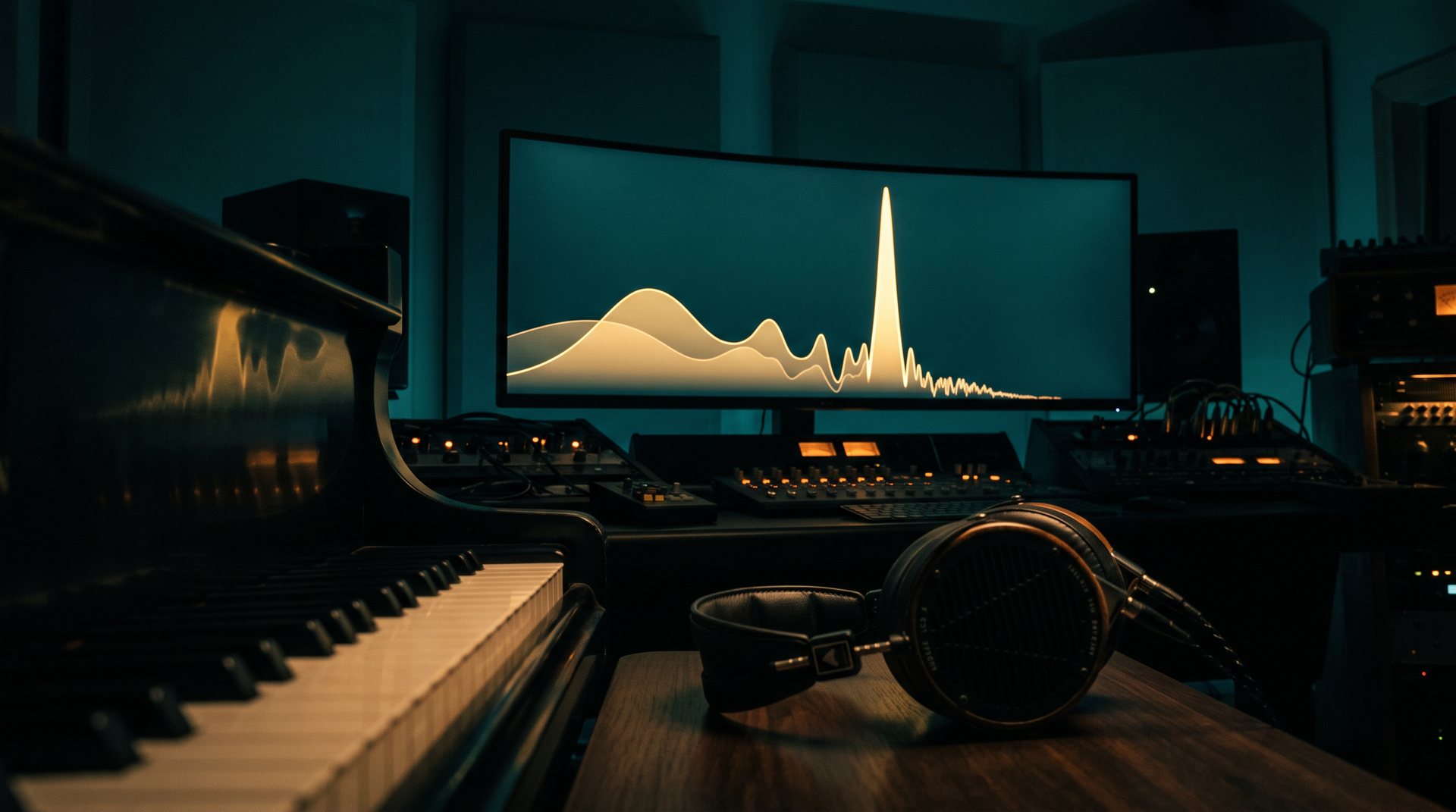
“528 Hz.” “432 Hz.” “963 Hz.” Titles like these are everywhere. But a title is only a promise. The only thing that tells you what a piece of music really contains is its spectrum – the picture of all the frequencies that sound in it.
That is why we have a simple rule: don’t trust the title, read the spectrum. Here we show you how we do it.
What a spectrum is
Every sound you hear is a mixture of vibrations. A piano note, for example, contains its main tone and a whole family of overtones above it. A mathematical method called the Fourier transform (in practice the FFT, the Fast Fourier Transform) takes a piece of audio apart and shows how strongly each frequency is present.
The result looks like a mountain landscape: on the horizontal axis the frequency in hertz, on the vertical axis the strength. A pure tone of 528 Hz shows up as one sharp, narrow peak at exactly 528 Hz.
Why the title can be wrong
There are two common reasons why a title and the spectrum disagree.
1. The music is tuned to a different reference pitch. Most music today is tuned so that the note A sounds at 440 Hz. In that tuning, the note C above it sounds at 523.25 Hz – not 528 Hz. To place C exactly on 528.00 Hz, the whole piece must be tuned to A = 444 Hz. In A = 432 Hz tuning, the same C would sound at 513.74 Hz.
| Reference pitch | The note C5 sounds at | Distance to 528 Hz |
|---|---|---|
| A = 432 Hz | 513.74 Hz | −14.26 Hz |
| A = 440 Hz | 523.25 Hz | −4.75 Hz (about 16 cents) |
| A = 444 Hz | 528.00 Hz | exactly on target |
A difference of 16 cents is small – but it is real, and you can see it in a spectrum immediately.
2. The tone is not really in the track. Sometimes a frequency is named in the title but is missing, too quiet, or only present in a few minutes of a long video. A single measurement at the beginning does not show that.
How we measure every track
Before a Pure Soul track is released, we analyse the finished master – the exact file that goes online. Our measurement has four parts:
- Target tone, left and right. We look for the peak of the named frequency separately in the left and right channel. Thanks to long analysis windows and careful interpolation of the peak, we can read it more finely than 0.05 Hz. To pass, it must lie within ±0.5 Hz of the target.
- Tuning of the music. From all the strong overtones of the instruments we calculate the reference pitch – for a 528 Hz piano piece that should be A = 444 Hz. We express the deviation in cents (one hundredth of a semitone); the tolerance is ±3 cents.
- Stability. We divide the whole track into one-minute sections and check every section again. A 90-minute piece therefore has 90 checks; all of them must be on target.
- Clean sound. No hum, no hiss, no distortion.
Only when everything passes is the track released – and only then may its title and thumbnail name the frequency.
An example
This is the certificate of our 90-minute piece 528 Hz Piano, Forest Stream & Birdsong:
| Check | Target | Measured | Result |
|---|---|---|---|
| Target tone left / right | 528 Hz | 528.000 Hz / 528.000 Hz | passed |
| Tuning | A = 444 Hz | A = 443.86 Hz (−0.5 cent) | passed |
| Stability | 90 sections | 90 / 90 on target | passed |
You will find a certificate like this in the description of every one of our videos.
Look for yourself
You do not have to believe us either. With the free audio program Audacity you can look at a spectrum yourself: open an audio file, select a few seconds and choose Analyze → Plot Spectrum. A larger “Size” gives you finer frequency detail. Look for the highest, sharpest peak and compare it with the title.
A small tip: the longer the piece of audio you analyse, the finer the frequencies you can tell apart. One second of audio separates frequencies about 1 Hz apart; twenty seconds already separate 0.05 Hz.
Why we care so much
Our music is made for relaxation and wellbeing – it is not a medical product, and we do not promise any effect. But if a title names a frequency, you deserve to hear exactly that frequency. Measuring is our way of being honest with you.
Measured, not promised.
Letters from the Atlas
Once a month, at the new or full moon: new articles, a page from the calendar of the year and our newest music. Free, and you can unsubscribe at any time.
Sources
PURE SOUL ATLAS
More from the Atlas

The Cosmic Octave: How the Planets Sound
In 1978 Hans Cousto turned the orbits of the planets into audible tones – with the same octave rule we use for our light colours. We recalculated his tones and gave each one its colour.

The 110 Hz Chambers: Newgrange, Malta and the Tone in the Stone
Acousticians measured ancient stone chambers in Britain, Ireland and Malta – and found that many of them answer most strongly between 95 and 120 Hz. What we know, and what remains a mystery.

The Light Octave: What Colour Is Your Tone?
Double a tone forty times and it becomes light. A gentle thought experiment that gives each of our ten frequencies a colour – and why 528 Hz turns green.