


5 min read
Level: Measured Acoustic measurements and archaeology – the builders’ intentions remain an open question.
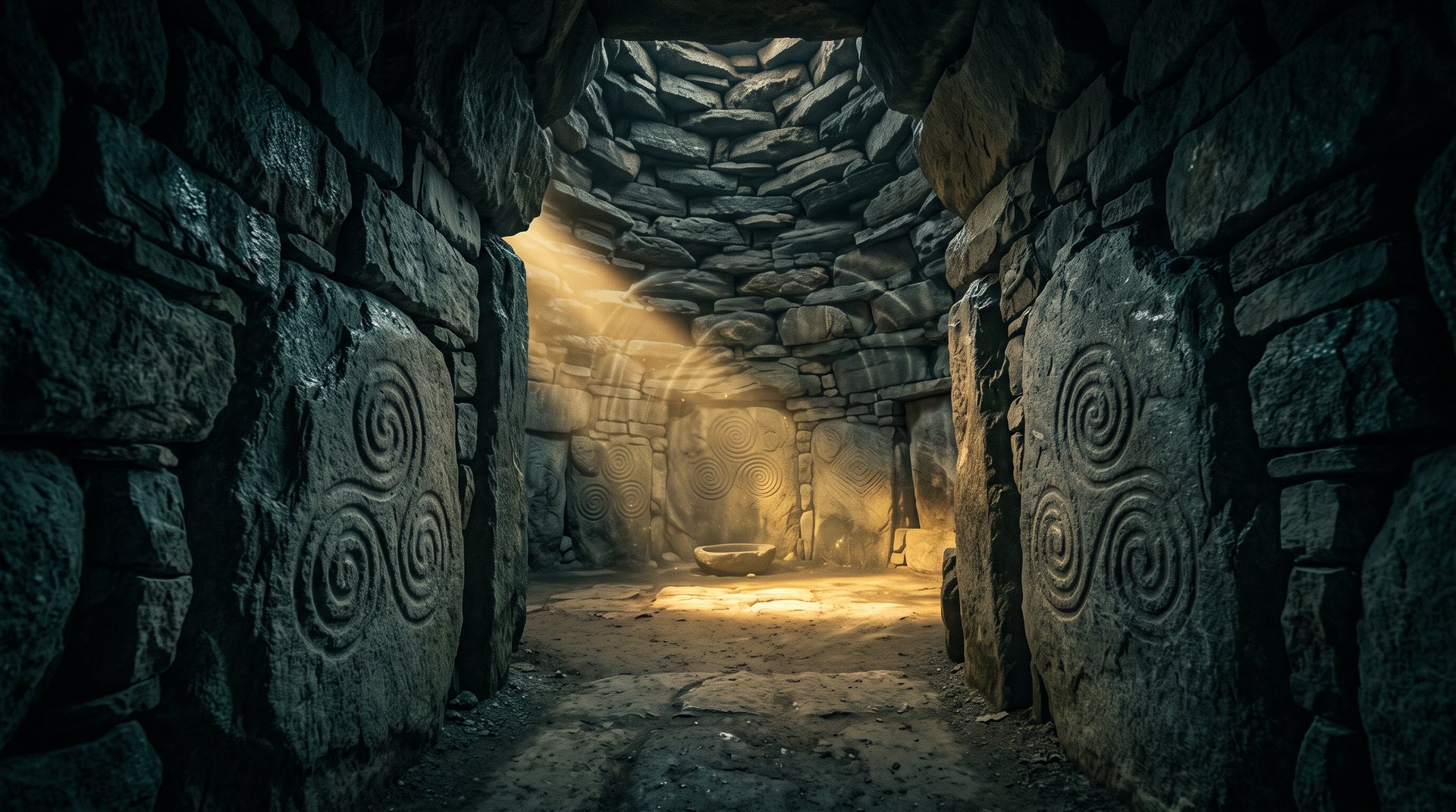
Picture yourself crouching through a narrow stone passage. The air is cool, the light behind you grows small. Then the passage opens into a chamber of huge, carefully stacked stones – built more than five thousand years ago. Someone begins to hum a low note. And suddenly the whole room seems to hum along.
This is not a fairy tale. It is the starting point of a young field of research called archaeoacoustics: the study of how ancient places sound – and whether their builders knew it.
Six chambers, one range
In the mid-1990s a team around the Princeton physicist Robert Jahn, together with the researcher Paul Devereux and Michael Ibison, carried a loudspeaker and measuring equipment into six ancient chambers in the British Isles. Five of them date from around 3500 BC, one from around 500 BC; among the sites tested were Newgrange in Ireland and Wayland’s Smithy in England.
They played slowly rising tones into each chamber and listened for the frequency at which the room answered most strongly – its resonance. The result, published in 1996 in the Journal of the Acoustical Society of America: every chamber had a strong resonance between 95 and 120 Hz, many of them close to 110 Hz.
That range is no coincidence for our ears: it lies right in the middle of the lower male voice. A deep, humming or chanting voice would have filled these rooms more easily than any other sound.
The Oracle Chamber of Malta
On the island of Malta lies the Ħal Saflieni Hypogeum, an underground complex cut into soft limestone. According to UNESCO it was used as a burial place from around 4000 to 2500 BC; its three levels reach down 10.6 metres below today’s ground. Since its discovery in 1902, visitors have noticed a special room: a small niche which, as UNESCO puts it, “echoes when someone speaks into it”.
Later measurements in Maltese temple rooms, reported in 2009, again found resonances at 110 to 111 Hz. UNESCO itself remains careful: the echo may not have been created intentionally – but it could have been used in rituals.
What 110 Hz does to a room – and to us?
In 2008 the psychiatrist Ian Cook and colleagues at UCLA asked a follow-up question. In a small pilot study, 30 healthy adults listened to tones between 90 and 130 Hz while their brain activity was recorded with EEG. At 110 Hz the pattern differed from the other tones – for example, activity over the left temporal region, which is involved in language, was lower.
We share this with care. It was a single pilot study with few participants, and the authors themselves call for larger studies. It says nothing about what our music does for you – and we do not make any such claim. What it shows is that people take the question seriously: did ancient builders shape stone in a way that changes how a voice feels in the room?
Light and sound in one place
At Newgrange the story becomes even more beautiful. Above the entrance lies a small opening, the roof box. Around the winter solstice, on the mornings from about 19 to 23 December, the rising sun shines through it and along the 19-metre passage until it lights the chamber floor – for about 17 minutes.
So the same chamber holds two things: a tone, near 110 Hz, that the room answers best, and a light, the golden beam of the shortest days. If we translate 110 Hz into our light octave (doubling it 42 times), it lands at around 484 terahertz, about 620 nanometres – a warm orange, the colour of firelight and sunrise.
| Place | Age | What was observed |
|---|---|---|
| Newgrange, Ireland | over 5,000 years | resonance 95–120 Hz; winter-solstice light for about 17 minutes |
| Wayland’s Smithy, England | around 3500 BC | resonance 95–120 Hz |
| Ħal Saflieni Hypogeum, Malta | use c. 4000–2500 BC | echoing niche; resonance reported at 110–111 Hz |
A tone we still use today
One small detail we love: in today’s standard tuning (A = 440 Hz), 110 Hz is exactly a low A – two octaves below the tuning note an orchestra plays before a concert. The chambers “stand” on a tone that is still our reference today.
What we know – and what we don’t
We know that many ancient chambers resonate strongly in the range of the male voice, and that some of them are aligned with the sun. We do not know whether the builders planned the resonance or whether it simply follows from the size of the rooms and the stones they used. Both are possible, and researchers still discuss it.
Perhaps that is exactly the gift of these places: they invite us to listen without needing an answer.
Letters from the Atlas
Once a month, at the new or full moon: new articles, a page from the calendar of the year and our newest music. Free, and you can unsubscribe at any time.
Sources
- Jahn, Devereux & Ibison (1996), "Acoustical resonances of assorted ancient structures", J. Acoust. Soc. Am. 99(2), 649–658 – cited in this ASA lay-language paper
- Stone Pages – Ancient temple acoustics (PEAR results, Maltese temples at 110–111 Hz, Cook 2008)
- Cook, Pajot & Leuchter (2008), "Ancient Architectural Acoustic Resonance Patterns and Regional Brain Activity", Time and Mind 1(1), 95–104
- UNESCO World Heritage – Ħal Saflieni Hypogeum
- Newgrange.com – Winter solstice
- Wikipedia – Roofbox (Newgrange)
PURE SOUL ATLAS
More from the Atlas
Don’t Trust the Title: How We Read a Spectrum
Many videos promise a frequency in their title. A spectrum shows whether it is really there. How we measure every Pure Soul track before release – and how you can look for yourself.

The Cosmic Octave: How the Planets Sound
In 1978 Hans Cousto turned the orbits of the planets into audible tones – with the same octave rule we use for our light colours. We recalculated his tones and gave each one its colour.

The Light Octave: What Colour Is Your Tone?
Double a tone forty times and it becomes light. A gentle thought experiment that gives each of our ten frequencies a colour – and why 528 Hz turns green.